
When I tell parents that I teach children to code, I often hear the same question: "But my child doesn't want to be a programmer. Is it still worth it?"
My answer is always yes. Coding is not only a path to a technology career. It is a way of teaching children to think, and those habits of mind help in school, at work and in everyday life. Here is what children gain when they learn to code.
1. They learn to solve problems step by step
Every program starts with a problem: "How do I make the star fall from the sky?" or "How do I keep score?" A child learns to take a big, confusing task and break it into small steps they can handle one at a time.
This skill helps with a long maths question, a school project, planning a science experiment, or even tidying a bedroom. Children learn that a big problem is just a series of small ones.
2. They learn that mistakes are normal
In coding, the first try rarely works perfectly. The character walks the wrong way, or the score goes down instead of up. Coders call this a bug, and fixing bugs is a normal part of the work.
Children learn to ask, "What did I expect to happen? What actually happened? What can I change?" They stop seeing mistakes as failures and start seeing them as clues. This builds resilience, which is one of the most valuable traits a child can carry into adulthood.
3. They practise logical and clear thinking
Computers follow instructions exactly, so children must be precise. They learn if/then thinking ("if the star touches the basket, then add one point"), sequences (the order of steps matters) and loops (repeating something efficiently).
This supports maths, science and clear writing, because all of them depend on putting ideas in a logical order.
4. They become creators, not just consumers
Children today spend a lot of time with games, videos and apps. Learning to code shifts them from using technology to making it. A child who builds their own quiz game or animation understands that technology is something people create, and that they can create it too.
5. They express their creativity
Coding is creative work. A child designs characters, chooses colours and sounds, invents a story and decides how the game should feel. Two children given the same lesson will build two different games.
This matters for children who don't think of themselves as "technical". Many artistic, imaginative children discover that coding is another way to bring their ideas to life.
6. They learn patience and focus
A coding project can't be finished in a few seconds. Children learn to stay with a task, test it, adjust it and try again. In a world of quick scrolling, learning to concentrate on building something is a skill in itself.
7. They learn to explain their thinking
In a good coding class, children don't just build. They explain: "This block makes the star fall, and this one makes it start again at the top." Explaining their ideas builds communication skills and shows whether they truly understand.
Working in pairs or showing a project to the class also teaches children to share ideas and give and receive feedback kindly.
8. They get ready for a world full of technology
Whatever your child becomes, whether a doctor, farmer, teacher, designer, business owner or engineer, they will work with technology. Children who understand the basics of how software works feel more confident and curious about new tools, and are less intimidated by them.
🏡 How You Can Support Your Child at Home
You don't need to know anything about coding.
- Ask them to show you. "Can you explain how your game works?" is one of the best questions you can ask.
- Praise effort and persistence, not just finished projects. "I saw how you kept trying to fix that bug" matters.
- Let them struggle a little before you help. The learning happens in the struggle.
- Encourage them to personalise projects with their own characters, stories and ideas.
- Keep screen time balanced, and make sure creating time is part of it.
✨ The Takeaway
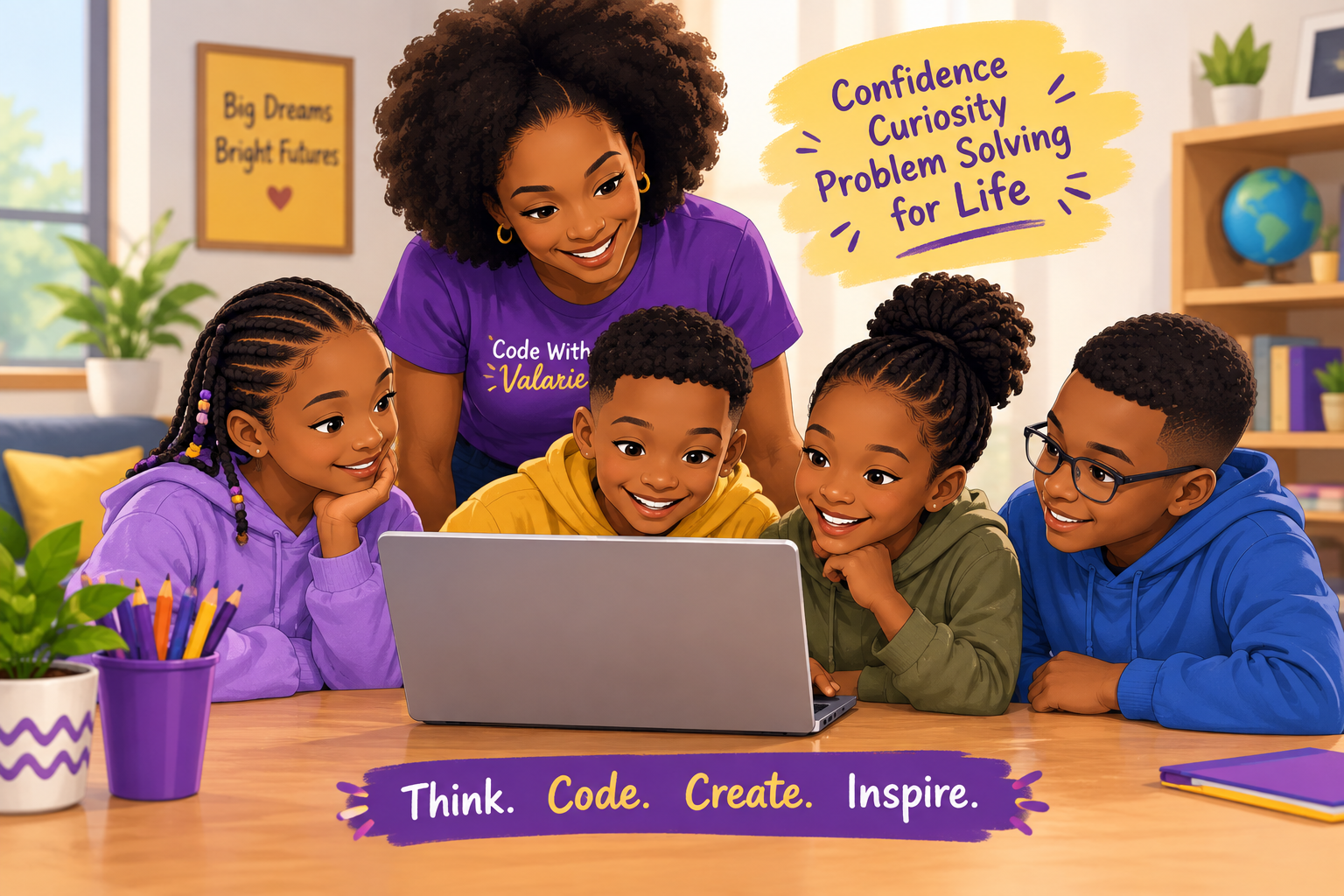
Learning to code is not about producing a generation of programmers. It is about giving every child confidence, curiosity and the ability to think through problems. Those are skills for life.
💜 No Child Left Behind
At Code With Valarie, my belief is simple: no child left behind. Every child deserves the time and support to understand an idea before moving to the next one.
Think. Code. Create. Inspire.